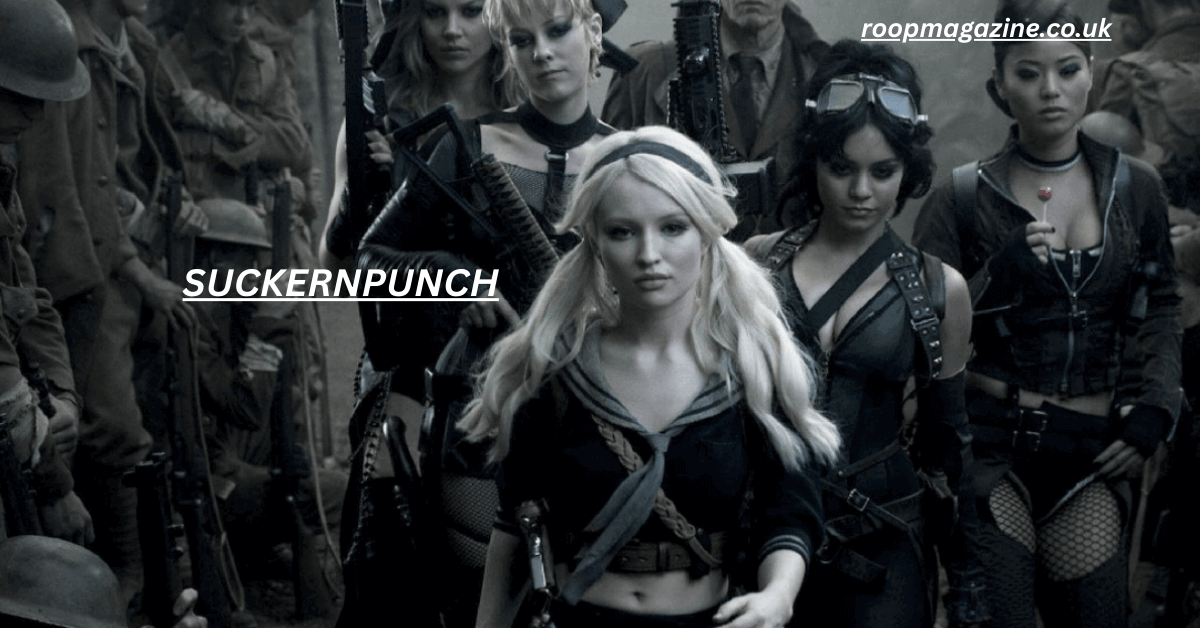
More than a typical action‑fantasy film, Sucker Punch has become a cultural artifact blending cinematic spectacle, psychological drama, and subcultural aesthetics. Its heady mix of trauma, escapism, female empowerment, violence, and stylized combat draws viewers into a world where imagination becomes survival. Over a decade after its release, the film continues to spark fascination — among fans, critics, cosplay communities, and pop‑culture commentators — proving that its influence extends well beyond the silver screen.
What Is SuckernPunch? — Film Overview and Significance
Sucker Punch is a 2011 American fantasy‑action film directed by Zack Snyder, co‑written by Snyder and Steve Shibuya. Wikipedia+1 The movie centers on a young woman, “Babydoll” (portrayed by Emily Browning), who is institutionalized in a mental facility under traumatic circumstances. As she plans her escape, Babydoll retreats into vivid, fantastical dream worlds where she and other inmates transform into powerful warriors fighting mythical and dystopian enemies.
The ensemble cast includes not just Browning, but also Abbie Cornish, Jena Malone, Vanessa Hudgens, Jamie Chung, and others — representing a group of women whose inner lives and traumas fuel the film’s allegorical and emotional weight.
The film’s genres — fantasy, action, psychological drama — combined with its original-concept status (rather than being based on a book, comic, or preexisting franchise) make it stand out.
Given its ambition, surreal visuals, and thematic boldness, Sucker Punch occupies a unique place in modern cinema: not a universally beloved film, but one whose intentions and stylistic risks continue to draw re-evaluation, discussion, and even admiration.
Origins and Cinematic DNA
At its heart, Sucker Punch was a risky bet. As one of the relatively few large‑budget Hollywood films based on an original idea (no novel or comic book backing), it faced structural disadvantages from the start. The production budget reportedly ranged from US $75–82 million.
“Original” films seldom guarantee box-office success — studios generally prefer pre-sold properties, franchises, or recognizable IP. By 2011, when Sucker Punch released, audiences’ appetites were largely dominated by big franchises.
Upon release on March 25, 2011 (in conventional and IMAX theaters), the film opened with about US $19.06 million in its first weekend domestically. Its worldwide gross eventually reached approximately US $89.8 million — modestly above its estimated budget, but still considered underwhelming, especially when marketing/distribution costs are factored in.
Critically, it suffered. On review aggregator site Rotten Tomatoes, the film holds a mere 22% approval rating (based on 219 reviews), with critics calling it visually dazzling but narratively hollow. Metacritic similarly scored it 33/100.Many writers compared the film to a video game — praising the spectacle but faulting lack of character depth and story coherence.
Still, the seeds of its enduring legacy were sown early: stylized visuals, audacious fantasy, and subversive themes that many mainstream critics missed — but which resonated with a niche audience. Over time, as cultural conversations expanded around representation, trauma, escapism, and female agency, Sucker Punch began to be reinterpreted, reevaluated, and, for some, embraced.
Core Themes — Trauma, Empowerment, and Escapism
At the core of Sucker Punch lie heavy themes: trauma, oppression, and the yearning for freedom. The narrative device — a young woman institutionalized and threatened with a lobotomy — situates the film in a psychological and emotional space where reality is unbearable.
Female Empowerment as Rebellion
In her fantasy sequences, Babydoll and her companions metamorphose into warriors — confident, capable, and in control. Their transformation becomes a metaphor for reclaiming agency: from powerless institutionalized women to empowered fighters. This reclamation resonates as a form of rebellion, a refusal to remain victims. When viewed through this lens, the film becomes a statement: even when reality is oppressive, the mind can resist.
That said, this empowerment is complex, not unambiguous. Because the film blends sexualized imagery, violence, and fantasy, it walks a fine line between reclamation and exploitation. Many critics took issue with the way the female body and violence are depicted — a tension that fuels the film’s controversial status.
Trauma, Oppression, and Fantasy as Coping Mechanism
Babydoll’s retreat into fantasy is not mere escapism — it’s a psychological survival strategy. The horrors of her real life (abuse, institutionalization, imminent lobotomy) are reframed through surreal dream quests. Each fantasy battle, each fantastical enemy, becomes a symbolic confrontation with trauma, fear, and the societal structures that victimized her. This layering lends the film psychological complexity: the dream world acts as a space where pain is confronted, reconfigured, and momentarily mastered.
Escape, Resistance, and Reclaiming Agency
The ultimate goal for Babydoll and her friends: retrieving certain symbolic items that would allow their escape. Each mission in the fantasy world mirrors the characters’ fight for real freedom. In this sense, fantasy becomes resistance; survival becomes defiance. The film’s structure — nested realities, dream logic — turns the narrative into an allegory of oppression and psychological resistance.
Visual World and Design
One of Sucker Punch’s most defining (and divisive) elements is its visual style. It blends steampunk, surreal dreamscapes, dystopian warzones, mythic fantasy, and anime‑inspired action — producing an aesthetic that’s as ambitious as it is jarring.
Surreal Dreamscapes and Steampunk / Dystopian Aesthetics
Through its fantasy sequences, the film transports viewers to war-torn battlefields, samurai arenas, dragon‑haunted castles, and futuristic dystopias. The blending of mechanical war‑machinery, fantastical beasts, and gothic architecture creates an industrial‑steampunk vibe that feels dislocated from reality — and deliberately so. This visual radicalism underscores the film’s thematic ambition, externalizing internal trauma and psychological struggle into vivid external landscapes.
Layered Realities: Asylum → Brothel Hallucination → Fantastical Battle Worlds
The film doesn’t present a single world but a cascade of layered realities: the physical asylum, the brothel‑hallucination (in Babydoll’s mind), and the full-blown fantasy worlds. This dream-within-dream structure reflects deeply on the nature of trauma: reality becomes too painful, so the mind seeks refuge — but even refuge must be fought for. The shifting aesthetics mark emotional states: oppression, resistance, hope, despair.
Symbolic Objects: Weapons, Keys, Costumes, and Color Palettes
In Sucker Punch, objects — guns, swords, keys, maps — are heavily symbolic. Weapons represent liberation; keys hint at escape; maps show the path from captivity to freedom. Costumes (fetishized, militarized, fantastical) reflect transformation, identity, and control. Meanwhile, color palettes shift along with emotional tone — from dreary institutional grays to vibrant fantasy hues — mapping psychological transitions visually.
Choreographed Combat and Performance as Narrative and Metaphor
The film’s action isn’t raw or realistic — it’s choreographed, stylized, almost balletic. Gunfights, sword fights, dragon battles — each sequence is sculpted for impact, visual poetry, and metaphor. The choreography becomes a language of resistance, defiance, and reclaiming agency. This dance-like violence blurs the line between performance and survival.
Character Dynamics and Emotional Depth
While visuals often dominate discussions of Sucker Punch, its characters and their emotional journeys provide the film’s heart.
Babydoll — The protagonist — embodies vulnerability, trauma, and longing for freedom. Her fantasies reflect not escapism alone but a desperate fight for survival and agency.
Her companions — Sweet Pea, Rocket, Blondie, Amber — are not just background; they represent solidarity, shared trauma, conflicting motivations, sacrifice, hope, and despair. Their group dynamic underscores themes of sisterhood, survival, and resilience, even in the face of overwhelming odds. Their relationships highlight loyalty, sacrifice, fear, hope, and sometimes betrayal — human elements grounding the surreal fantasy.
In this psychological and emotional terrain, Sucker Punch offers more than spectacle: it offers a lens into how people — especially vulnerable, oppressed individuals — might use fantasy, performance, solidarity, and inner strength to resist and survive.
Soundtrack and Cinematic Impact
An often underappreciated but crucial component of Sucker Punch is its soundtrack. The film’s musical choices — haunting, atmospheric, emotionally resonant — amplify every fantasy sequence, emotional beat, and dramatic turn. In fact, the soundtrack achieved commercial success: in its first week in the U.S., it sold 16,000 copies; within two weeks, it rose on the charts to eventually top the “Top Soundtracks” chart.
By the end of the year, the soundtrack had reportedly sold over 117,000 units in the U.S., making it one of the best-selling film soundtracks of 2011.
This musical dimension deepens the film’s emotional and psychological impact. The score and song choices help blur the boundaries between reality and fantasy — making viewers feel the instability, longing, and intensity that drive Babydoll’s inner world. In doing so, the soundtrack becomes not just accompaniment but a key part of storytelling.
Real‑World Influence and Subculture
Though commercially unsuccessful and critically panned, Sucker Punch has enjoyed a remarkable afterlife — in fandom, cosplay, subculture, fashion, and online discourse.
Cosplay, Fan Art, and Visual Reinterpretations
The film’s distinctive aesthetics — steampunk‑military, fantasy armor, corsets, gas masks, dystopian backdrops — have inspired cosplay communities. Fans reinterpret and recreate the characters’ outfits and settings in conventions, photoshoots, and fan art. This participatory culture keeps the film alive long after theatrical release.
Fashion and Aesthetic Impact:
Elements of Sucker Punch’s design — metallic textures, corsetry, militarized glam, dystopian steampunk — have influenced fashion editors, alternative style photographers, and fashion subcultures. The blend of fantasy, grit, and glamour resonates with those drawn to rebellious or subversive aesthetic statements.
Online Culture: Memes, GIFs, Symbolic References, Social‑Media Re‑contextualization
In online spaces, scenes, quotes, and visuals from Sucker Punch circulate as memes, GIFs, and shorthand for defiance, style, “girl‑power,” or dark glamour. Detached from their original narrative, these elements become symbolic language — used in social media, art, digital commentary — and give the film a second life through reinterpretation.
Niche, Fringe Interpretations:
For a small subset of subculture participants, Sucker Punch has also inspired more fringe uses — romanticizing sudden or aggressive confrontation, massive stylized violence, or “street-fighting” mentality. While this remains marginal, it underscores how fictional media can be misinterpreted or re-appropriated beyond the original intent, raising ethical questions about responsibility and the power of aesthetics.
Controversies and Ethical Considerations
With bold ambition come bold criticism. Sucker Punch has long been polarizing — and not just for its aesthetic excess.
Glamourizing Violence, Objectification, and Sexualization
Critics have often argued that the film exploits female bodies and treats violence against women as spectacle. The blend of sexualized imagery, graphic violence, and fantasized combat raises uncomfortable questions: does aestheticization of trauma desensitize? Does it undermine the gravity of the subject matter? Many reviewers believed that the film emphasized style over substance, resulting in “eye‑catching images” but lacking meaningful character depth.
Narrative Weakness:
While visuals, music, and design are undeniably striking, critics frequently pointed to a lack of character development, weak plot structure, and incoherent narrative logic — especially when compared to the grandeur of the visuals. The film’s blending of genres — fantasy, drama, action — sometimes muddles tone and leaves audiences uncertain of how to interpret what they see.
Ethical Responsibility and Audience Interpretation
Because the film deals with trauma, abuse, and mental health (institutionalization, forced lobotomy, sexual exploitation), reinterpreting it through glamour and fantasy can be ethically fraught. The risk is that viewers may consume pain and suffering as stylized entertainment rather than engaging with the underlying trauma. The potential desensitization, trivialization of serious themes, or misinterpretation — especially by younger or less media‑literate audiences — remains a valid concern.
Cult Status and Pop Culture Legacy
Despite initial failure, Sucker Punch has gradually attained cult — or at least borderline cult — status. Why? Because many of the elements studios and critics derided: style over substance, surreal visuals over realism, female ensembles over male‑dominated casts — those same “flaws” now appear to many as boldness, risk, and subversive artistry.
Comparison with Other Cult Classics:
Like Fight Club or Mad Max: Fury Road (to varying degrees), Sucker Punch is divisive, morally ambiguous, and visually distinctive — traits often associated with cult cinema. Its willingness to challenge conventional storytelling and embrace aesthetic daring positions it as a film ahead of its time, or at least outside mainstream comfort zones.
Influence on Visual Storytelling, Genre‑Blending, and Subcultural Adoption
The film’s hybrid of fantasy, psychological drama, action, steampunk, and surreal imagery predates and perhaps anticipates the growing appetite for genre‑blending stories in cinema, gaming, and digital media. Its adoption by subcultures (cosplay, alternative fashion, remix culture) suggests that its impact is not only cinematic but also cultural and aesthetic.
Over time, as media literacy evolves and audiences reexamine past failures with fresh eyes, Sucker Punch’s reputation benefits — not as a flawless film, but as a bold experiment, a mirror reflecting underlying tensions about gender, fantasy, trauma, and power.
Lessons from SuckernPunch
Ambiguity as Artistic Strength
One key lesson from Sucker Punch is that ambiguity — in theme, tone, moral clarity — can be a strength. By refusing to provide easy answers or simplistic morality, the film invites multiple readings: feminist allegory, tragic fantasy, cautionary tale, aesthetic manifesto. That open‑endedness allows for reinterpretation, debate, and longevity.
Power (and Danger) of Aesthetics
Visual style is powerful. It can amplify internal states, emotional truths, symbolic meaning. But it can also obscure, distort, or trivialize trauma. The film demonstrates that creators should wield aesthetic power responsibly — aware of how images, music, and spectacle impact audience perception and emotional response.
Fantasy and Imagination as Psychological Outlet
Sucker Punch dramatizes how imagination, fantasy, and inner world-building can function as coping mechanisms, survival strategies, or resistance tools for people facing trauma or oppression. This insight resonates beyond cinema — hinting at larger truths about human resilience, internal agency, and the psychological power of storytelling.
Conclusion — Lasting Cultural Impact
More than a decade since its release, Sucker Punch remains controversial — but also oddly alive. Its visual ambition, thematic daring, and plastic‑fantasy aesthetic continue to resonate with new generations: those drawn to subculture, those questioning societal standards, those craving stories that blur reality and dream.
While it may never achieve mainstream classic status, Sucker Punch has carved out a niche: a testament to the power of bold, unapologetic filmmaking; a reminder that failure — commercial or critical — doesn’t preclude influence; and a case study in how trauma, fantasy, gender, and aesthetics can collide to create something haunting, provocative, and unforgettable.
FAQs
Q1. What is the basic premise of Sucker Punch?
A: The film follows Babydoll, a young woman institutionalized under dire circumstances, who escapes into layered fantasy worlds where she and other women fight to gain freedom.
Q2. Who are the main characters and cast?
A: Key characters include Babydoll (Emily Browning), Sweet Pea (Abbie Cornish), Rocket (Jena Malone), Blondie (Vanessa Hudgens), Amber (Jamie Chung), among others. The movie is directed by Zack Snyder.
Q3. What makes its visual style unique?
A: The film merges steampunk and dystopian aesthetics with surreal dreamscapes — from war zones to mythical battlefields to fantasy castles — using strong symbolic visuals, color palettes, surreal choreography, and heavy CGI-driven action.
Q4. Why was the film controversial?
A: Critics accused it of emphasizing style over substance, glamorizing violence and sexualizing women, trivializing trauma through spectacle, and offering weak character development and narrative depth.
Q5. Does Sucker Punch have a cult following?
A: Yes — despite negative reviews and box‑office underperformance, it has gained a dedicated fanbase over time, particularly among those who appreciate its aesthetic, ambition, and subversive themes.
Q6. What themes does the film explore?
A: Trauma, escapism, empowerment, control, freedom, psychological survival, sisterhood, resistance, identity, and the blurred line between reality and fantasy.
Q7. How has the film influenced fashion, fandom, and online culture?
A: Its unique visuals inspire cosplay, fan art, alternative fashion (steampunk/industrial/militarized stylings), and aesthetic subcultures. Online, scenes and quotes have become memes, GIFs, and symbolic shorthand for rebellion, style, and defiance.
Q8. Is the film based on real events?
A: No — Sucker Punch is a wholly fictional narrative, blending fantasy, psychological drama, and surreal metaphors to explore internal states, not to depict or reconstruct real events.
Q9. What does the ending mean — is it hopeful or tragic?
A: Interpretations vary. On one level it can be read as tragic or ambiguous (trauma unresolved, escape incomplete). On another, it can be viewed as symbolic: even if physical freedom isn’t achieved, the act of imagining resistance, solidarity, and combat becomes a form of psychological survival — a kind of internal victory.
Q10. Why should modern viewers revisit Sucker Punch?
A: Because its themes — trauma, power, identity, escapism — remain relevant. Its fusion of genre, aesthetic boldness, and psychological metaphor makes it uniquely positioned to provoke discussion and re‑interpretation in a time when media, identity and subculture are deeply intertwined.
Leave a Reply